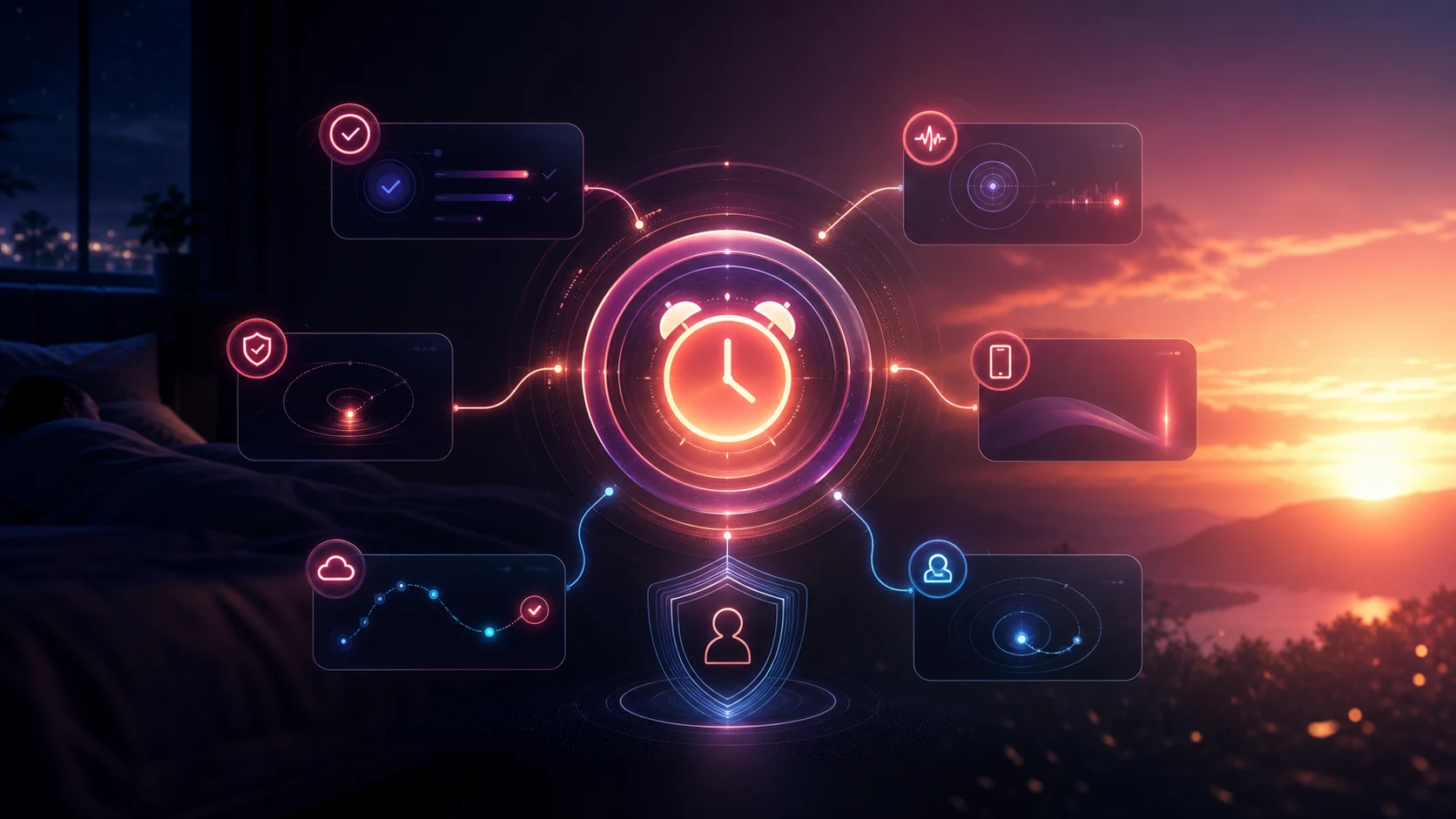
Use bedtime as the inspection point. Riso can check the practical weak spots before you rely on the alarm, so tomorrow does not become a surprise test of settings you never saw.
Find the failure while you can still fix it
You don't want to discover at 6:00 that the phone was almost dead, the volume was low, the mission needed camera access, or the alarm path was weaker than you assumed. By morning, the consequence is already moving.
A readiness check is boring in the right way. It looks at the practical pieces that make a wake plan believable before sleep takes over. That includes power, sound, permissions, mission setup, and whether the alarm has a workable way to reach you.
A nightly check beats another backup alarm
Adding five more alarms often repeats the same problem five times. If the device is muted, the target is missing, or the mission cannot run, more copies do not help much. You need a different question: is this setup ready enough for the morning I am asking it to protect?
Run the check before important mornings and after changing settings, updating the phone, choosing a new mission, travelling, or sleeping somewhere unfamiliar. Then stop checking. You have done the useful part.
Use the warning as a decision, not a panic cue
If the check finds an issue, choose the simplest repair: charge the phone, raise volume, choose a mission that does not need missing access, or set one independent backup. Do not redesign your whole life at midnight.
The win is not feeling perfectly certain. It is removing the avoidable failures while you are awake enough to make a clean choice.
What a useful preflight actually checks
A shallow alarm check only asks whether an alarm exists. A better check asks whether tomorrow's alarm can survive the real phone and room it has to live inside.
Look for the parts that commonly break at the worst time. Some are technical, like battery and volume. Some are behavioral, like choosing a photo target you never set up. Some are situational, like sleeping in a hotel where the barcode is not available.
- Can the alarm reach you with the current sound, volume, and phone position?
- Do the chosen missions have the access and targets they need?
- Is the phone charged enough to last through the night?
- Did a recent phone update, Focus setting, or travel day change the setup?
- Is there a real backup if tomorrow has serious consequences?
Use different checks for different mornings
A normal Tuesday does not need the same inspection as a flight, exam, early shift, or first day at a new job. For ordinary mornings, the check can stay lightweight. For can't-miss mornings, make the setup prove itself before you sleep.
That might mean choosing a simpler mission, adding a separate backup device, or moving the alarm route to a place you cannot avoid. The point is not to create fear. It is to make the important morning less dependent on hope.
Common questions
Should I check alarm settings every night?
No. Check before important mornings, after phone or app changes, and when you change a mission or sleep somewhere new.
Can a readiness check promise the alarm will work?
No alarm can promise that nothing will fail. A check reduces avoidable weak spots; it does not remove every possible risk.
What should I do if the setup is not ready?
Use the smallest reliable repair: charge the phone, pick a mission that is ready, move the phone, or set one independent backup for the next morning.
Sources & further reading
We use primary public-health guidance and original research where the topic makes factual claims about sleep. Sources are reviewed for relevance, not used as decoration.
